
Latest Research from UAIS Laboratory of Lanzhou University Reveals Behavioral Phenotypes of Smartphones in Depression Assessment
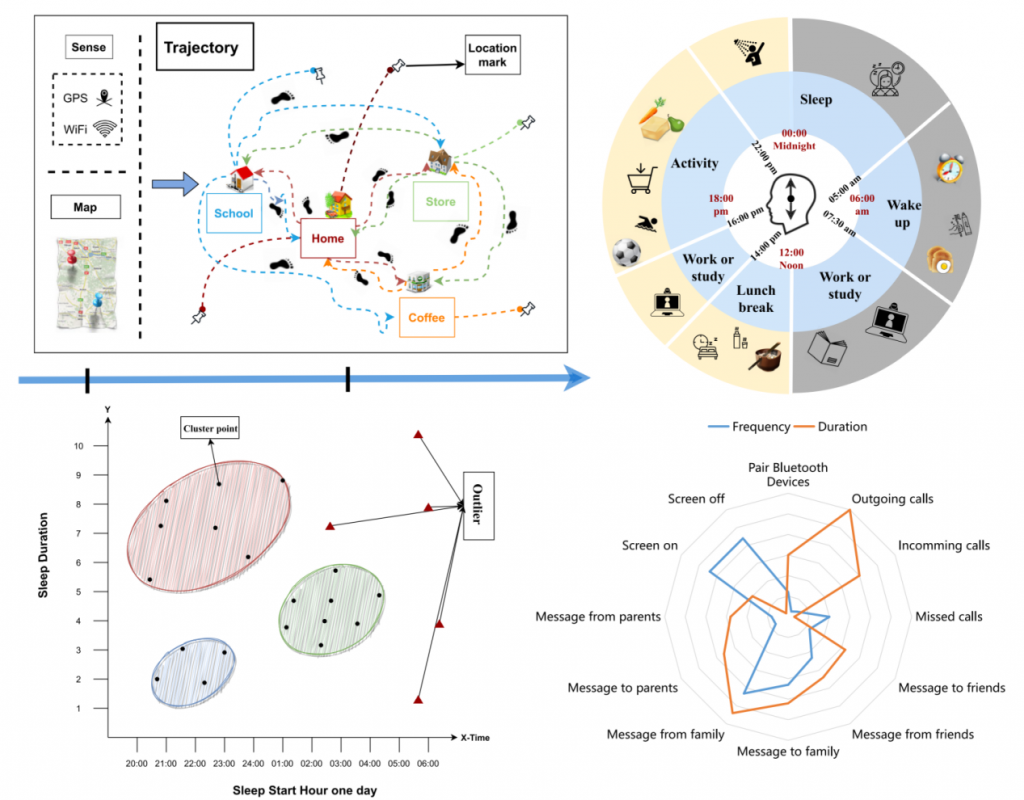
Recently, Associate Professor Minqiang Yang from the UAIS Laboratory, School of Information Science and Engineering, Lanzhou University, as the first author, published a research paper titled Digital Phenotyping and Feature Extraction on Smartphone Data for Depression Detection in the regular issue of Proceedings of the IEEE, a flagship journal of the IEEE. Professor Bin Hu and Professor Xiping Hu served as the co-corresponding authors of the paper. This paper conducts a comprehensive and in-depth analysis of several key issues related to ubiquitous sensing technology, aiming to provide stronger and more effective auxiliary support for the detection of Major Depressive Disorder (MDD). The paper systematically reviews existing research on digital phenotyping using smartphone data, summarizes potential detection methods for MDD, and innovatively elaborates on five representative categories of features from the perspective of digital phenotyping. These five categories of features are as follows: location features that reflect an individual’s activity range and trajectory; motion features that indicate an individual’s movement status and activity level; sleep features that contain key information such as sleep duration and quality; circadian rhythm features that characterize the temporal patterns of an individual’s daily activities; and social interaction and device usage features that record an individual’s social interaction patterns and mobile phone usage habits. In addition, in view of the limitations of current research, the paper puts forward open questions, research challenges and solution strategies from the aspects of multimodal fusion, long-term longitudinal experiments, behavioral patterns, privacy issues of passive data, and neural mechanisms. It provides directional guidance for further research exploration and engineering applications in this field, and promotes the application of smartphones in the auxiliary diagnosis and treatment of mental disorders.
[News Background]
Proceedings of the IEEE ranks first in CiteScore in the field of computer science, with an impact factor of 23.2 (CAS Tier 1, CCF Class A, JCR Q1). It only published 43 papers in 2024. Renowned for publishing in-depth reviews, cutting-edge technical guidelines, and authoritative surveys, the journal is globally recognized by the academic community as a top benchmark in the fields of electrical engineering and computer science. This paper marks the first time Lanzhou University has published in Proceedings of the IEEE as the first-affiliated unit. The research group led by Minqiang Yang is committed to the research of artificial intelligence technologies in the universal diagnosis and treatment of mental disorders. They have published more than 20 papers in top-tier and first-class journals and conferences as first authors or corresponding authors. The team has developed the wearable eye tracker UEYE, achieving independent control and domestic substitution of wearable high-precision eye tracking technology, which has been applied to depression screening. Relevant technologies have obtained 5 authorized patents, and the related paper was published in TCSVT (a top CAS Tier 1 journal) and selected as an ESI Highly Cited Paper. Based on universal sensor data from “cameras + microphones”, the research group conducts depression recognition research and has achieved a series of influential results. Among them, the paper published in TKDE (a top CCF Class A journal) proposes a spatiotemporal attention multimodal collaborative perception model, which enables depression recognition in free conversation scenarios (also selected as an ESI Highly Cited Paper). In terms of non-pharmaceutical intervention for depression, the team carries out research on multimodal behavioral information feedback technology of large language models for depression intervention, and has been funded by a General Program of the National Natural Science Foundation of China.
Original link: https://ieeexplore.ieee.org/document/10915577