
Professor Mei Tian from Fudan University delivered an academic lecture to the faculty and students of our university
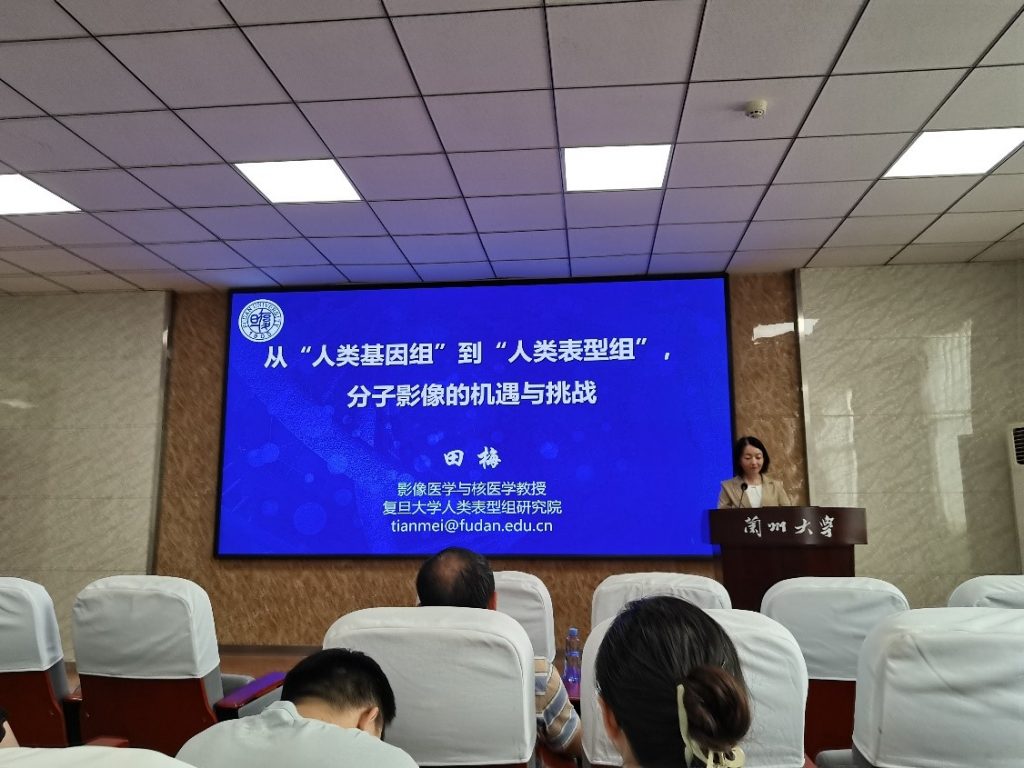
At the invitation of the UAIS Laboratory, School of Information Science and Engineering, Lanzhou University, Professor Mei Tian—Executive Dean of the Institute of Human Phenome, Fudan University, Distinguished Professor of the Changjiang Scholars Program under the Ministry of Education, recipient of the National Science Fund for Distinguished Young Scholars, leader of the Key Field Innovation Team of the Ministry of Science and Technology, and President of the World Molecular Imaging Society (WMIS)—delivered an academic report titled From Human Genome to Human Phenome: New Opportunities for Precision Medicine Based on Molecular Imaging in Conference Room 406 of Feiyun Building on July 26, 2024. Attendees of the report included relevant leaders of the school, young faculty members, master’s and doctoral students, as well as directors and deputy directors of multiple departments of the Affiliated Hospitals of Lanzhou University. The theme of the report not only involved the philosophical significance of human understanding of self, but also embodied the pioneering and forward-looking nature of the integration of multidisciplinary knowledge, bringing substantial gains to all participants. A phenome refers to the sum of all phenotypic characteristics exhibited by an organism or individual, including but not limited to the organism’s morphology, physiology, biochemical properties, and behavioral patterns. A phenotype is the result of the interaction between genotype (genetic information) and environmental factors. Phenome research helps us understand how organisms exert their genetic potential under different environmental conditions. The association study between phenome and genome is conducive to identifying genes that affect specific phenotypic characteristics, thereby furthering our understanding of the molecular mechanisms of genetic diseases. In addition, analyzing individual phenotypic characteristics enables more accurate disease diagnosis and provides personalized treatment plans for patients. The interdisciplinary research of phenomics, hybrid intelligence, and brain-computer interfaces is expected to achieve significant breakthroughs in personalized medicine and human-computer interaction in the future. By thoroughly exploring the interaction between individual biological characteristics and intelligent systems, it is promising to develop more intelligent and personalized medical solutions and brain-computer interface technologies. This will greatly improve patients’ quality of life and provide unprecedented communication and control pathways for people with disabilities. With the advancement of technology, the integration of these fields will deepen further, driving the progress of medical technology and social well-being.
Brief Introduction of Mei Tian
Distinguished Professor of Fudan University, Executive Dean of the Institute of Human Phenome at Fudan University, Distinguished Professor of the Changjiang Scholars Program under the Ministry of Education, recipient of the National Science Fund for Distinguished Young Scholars, leader of the Key Field Innovation Team of the Ministry of Science and Technology, and President of the World Molecular Imaging Society (WMIS). She has served as chief editor for 2 national unified textbooks and 2 English monographs, and associate chief editor for another 2 national unified textbooks. She has successively presided over a number of major research projects, including the National Science Fund for Distinguished Young Scholars, National Key R&D Program, Major Program of the National Natural Science Foundation of China, and Key International Cooperation Program of the National Natural Science Foundation of China. As corresponding author or first author, she has published more than 100 SCI papers and books, obtained 16 authorized patents, and led the formulation of 4 international expert consensuses and 1 Chinese expert consensus on PET molecular imaging diagnosis.